.png)
Cloud Modernized the Stack. AI Rewires the Enterprise.
Insights on private equity, vertical software, and the operating playbooks driving differentiated value creation in the AI era.

Familiar But Different
For the past two years, the dominant mental model for AI adoption inside enterprise has been cloud. The thinking goes, we’ve seen this movie before. New technology arrives, early adopters experiment, tooling matures, costs come down, and eventually the enterprise modernizes one application and one function at a time.
And in some ways, this analogy is correct. But it is also incorrect in some ways. Each technology cycle rhymes with the last, but it is not the same.
The Cloud Transformation
Cloud transformation shifted running applications, data and infrastructure from on-prem data centers to cloud platforms to take advantage of cloud’s scalability, flexibility and managed services. It enabled consuming IT and software as a service, and required modernizing application stack.
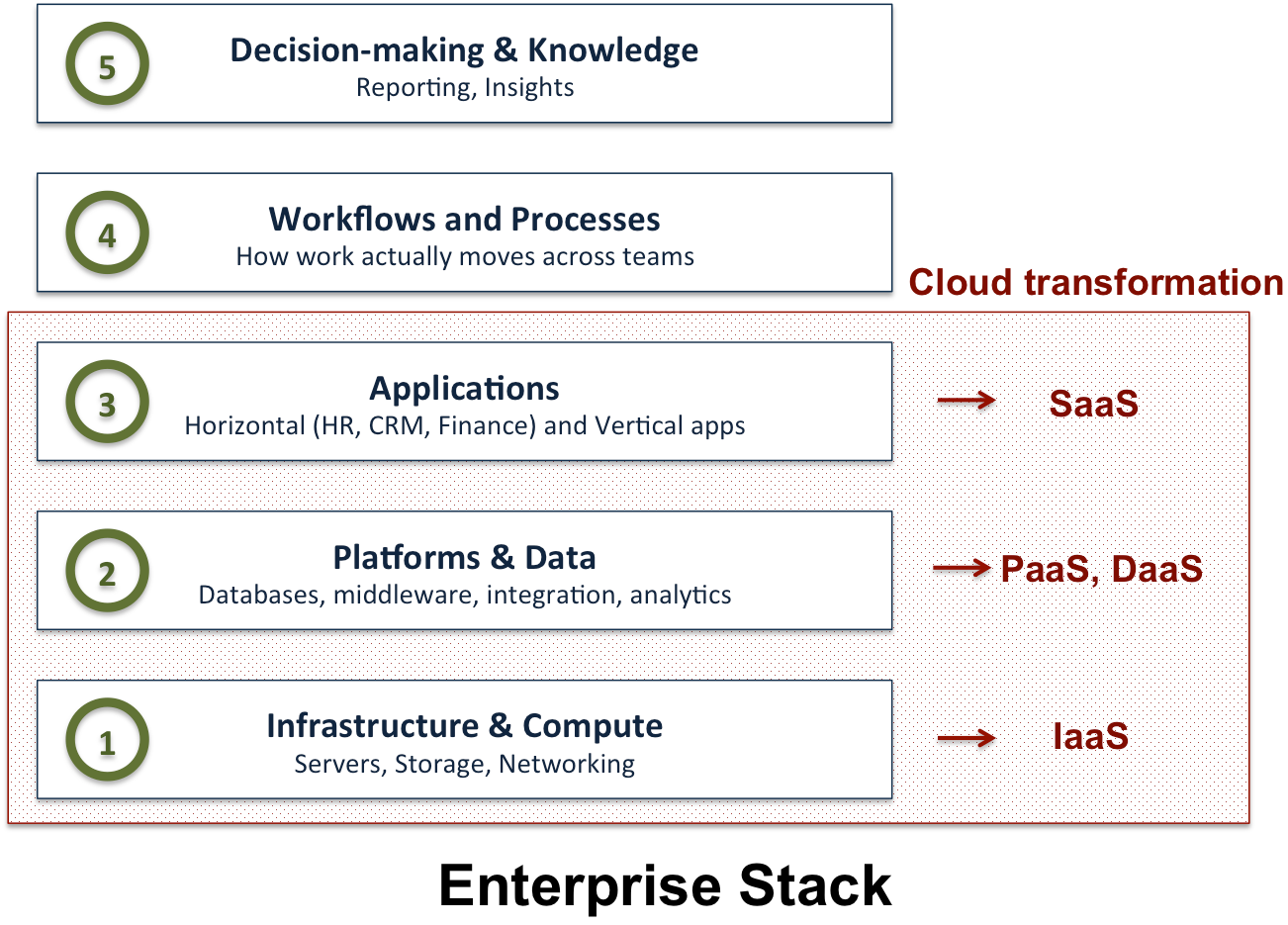
Cloud primarily transformed layers 1-3.
- Infrastructure and compute layer (IaaS): companies moved from owning servers and datacenters to using on-demand compute, storage and networking. This enabled turning capex into on-demand and metered infrastructure as a service.
- Platform and Data layer (PaaS, DaaS): teams shifted from running their own databases and middleware to managed platform and data services. This enabled offloading routine operations such as backups, scaling, patching, maintenance to the cloud provider
- Application layer (SaaS): users replaced custom software with subscription based software apps from the cloud. These services had built-in updates, maintenance and became operating expense for enterprises
However, the entire enterprise stack did not (have to) change at once. Cloud transformed the enterprise layer by layer and all the layers didn’t have to change all at once to create value.
Even the layers had multiple transformations and each layer could be modernized independently
- Infra: physical to virtualization to containerization
- Data: self‑managed DBs to cloud‑managed to serverless data warehouse
- Apps: on‑prem licenses to hosted to SaaS
Every incremental change unlocked value and benefits without requiring the entire stack to be rebuilt in one go. In addition, cloud allowed enterprises to modernize without organizational consensus i.e. each layer could be transformed by decisions from within the layer/org in the enterprise vs an org-wide consensus. The modularity is an important structural reason cloud transformation took over a decade and still succeeded.
This ability to progress without organizational consensus is an important way AI is different. This is where incumbents encounter their real constraint - not technology, but structure.
AI Enters The Same Stack
AI enters the enterprise through the same stack, which is why it feels familiar. Models run on compute. They consume data. They are embedded into applications. Early deployments look like tools.
- Infrastructure: GPUs, inference and cost curves associated with AI adoption
- Platforms and Data: RAG, embeddings, data access
- Applications: Copilots, code generation, document drafting, summarization etc. that look like SaaS add-ons
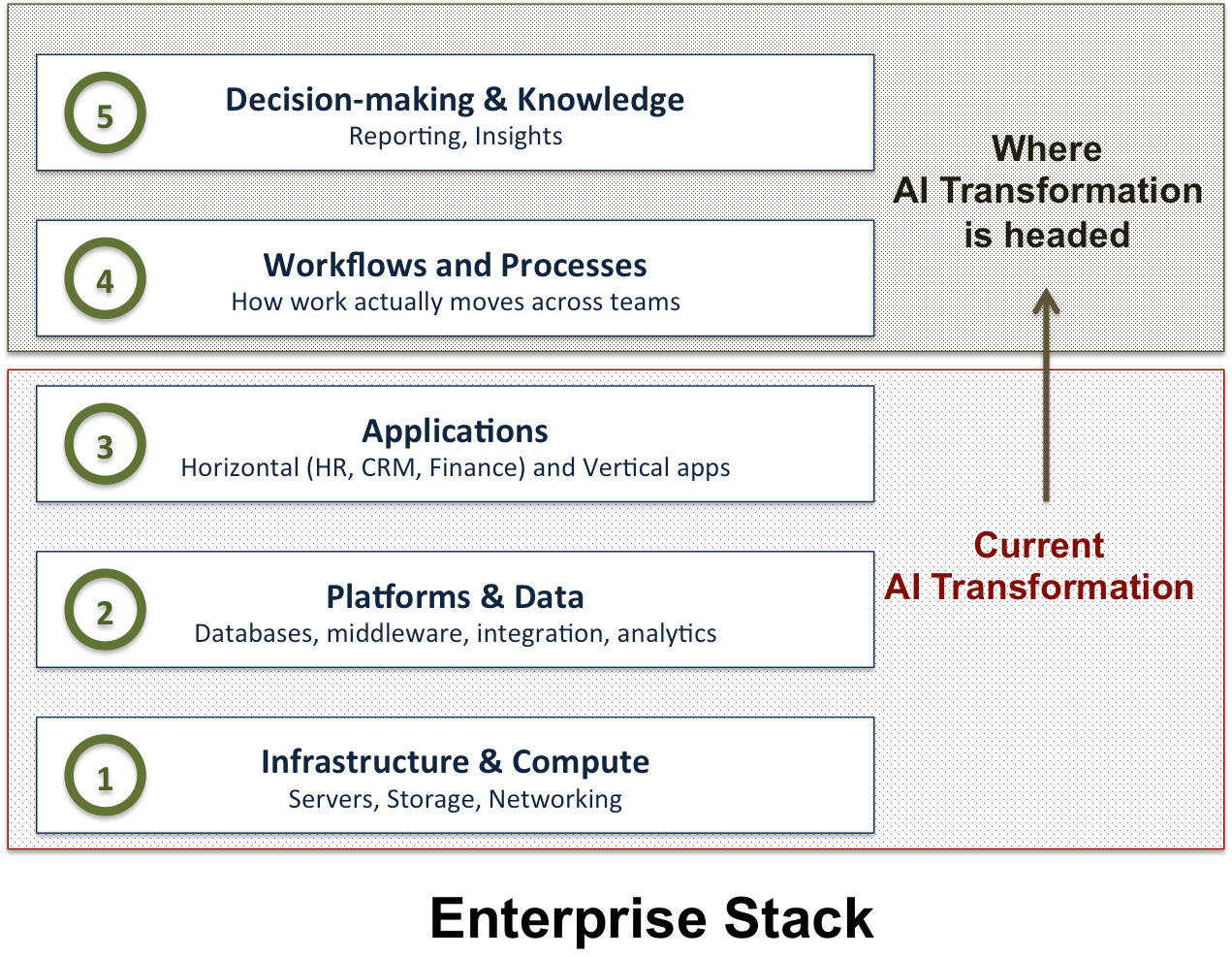
The AI tools that are being adopted are for local productivity. They work in silos and resemble SaaS tools. So, AI transformation appears to rhyme cloud transformation since it is currently operating at same layers 1-3. But this surface similarity hides a key difference.
How AI transformation is different from cloud
Cloud changed where software ran, whereas AI changes how work is performed i.e. it is workflow-centric. Unlike cloud, AI’s marginal value does not live just inside a single layer of the stack. It lives in the connections between them. For example:
- Customer Support AI needs engineering context
- Sales AI needs product + support signals
- Engineering AI benefits from customer feedback loops
So, AI features isolated in silos plateau quickly. The true value of AI is unlocked when these layers collapse and provide cross-functional context e.g. a Glean-like interface.
Even if AI started with a cloud-like adoption/transformation model, it will look different since
- Value across layers is more coupled in AI, whereas it was independent and additive in the case of cloud
- Cloud did not need org consensus and ownership, whereas AI exposes workflows and ownership gaps
- Cloud could work with fragmented data, whereas AI amplifies fragmentation problem
Cost played a different role in cloud adoption than it does in AI. Cloud costs scaled with usage, but value increased with adoption and each team could justify its own spend. AI costs (especially at inference time) scale with interaction, iteration, and duplication of context. When AI systems are deployed in silos, the same data is embedded, indexed, queried over multiple times across the enterprise. This makes fragmentation not just inefficient, but very expensive.
For AI transformation to be successful, few things matter
- Data layer: data maturity i.e. quality, ownership, permissions, semantic consistency is key to AI. Without these, AI will still be siloed. Cloud did not need this to deliver value. With cloud, lift‑and‑shift of a messy database onto managed infrastructure still delivered cost efficiency, reliability etc., whereas AI with messy schema impacts model’s behavior.
- Org design: successful AI transformation depends on process ownership, incentives, change management. Cloud mainly needed technical competence in networking, security, cost management etc., whereas AI needs clear process ownership, incentive changes, and a willingness to let machines make decisions.
- Glean layer is new: a full AI transformation will need a new nervous system that includes enterprise search, knowledge graphs to model entities/relationships, RAG to pull the right context, MCP to orchestrate tools, and agentic workflows that span multiple applications. Cloud never created this layer.
- Governance: AI introduces new risks associated with models, data leakage, hallucinations, IP exposure. And when the layers are connected, these risks quickly propagate across functions. For example, a misconfigured SaaS app can leak access to a few users, whereas misconfigured AI agent can leak data/patterns across systems with a bigger blast radius. So governance is needed earlier in AI than cloud ever required
The real long tail of AI
Cloud had a long tail because enterprises could modernize one piece at a time and still see value. AI may have a long tail for the opposite reason i.e. the biggest gains come only when you change multiple things together.
The constraint is not access to models or infrastructure. It is the willingness and ability to redesign workflows (how work gets done), data ownership (who controls the data), and decision-making (which decisions AI is allowed to influence or automate).
In that sense, AI does not just test an enterprise’s technical maturity. It tests its organizational maturity.
Interested in receiving more insights from Cover Drive Partners?
Subscribe below.